
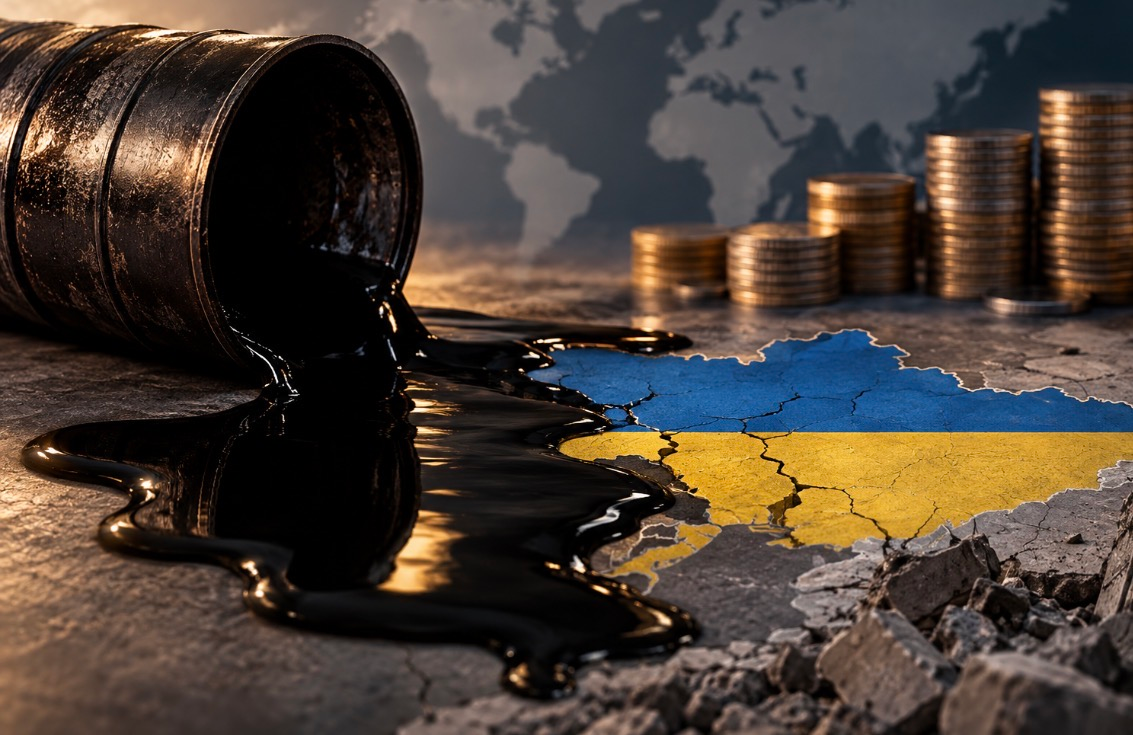
The United States, one of the world's largest fuel producers, is choosing to ease sanctions against Russia in order to import diesel. This decision raises serious questions regarding the consistency of U.S. policy, the financing of the war, and responsibility toward Ukraine.
A trade agreement that cannot be separated from the war.
On October 9, 2026, U.S. President Donald Trump announced that, following a phone call with Vladimir Putin, Russia would supply over 300,000 tons of diesel to the U.S. and international markets, followed by another 500,000 tons in November and one million tons subsequently.
In parallel, the US administration has temporarily authorized imports of Russian diesel, easing restrictions imposed in the wake of Russia's invasion of Ukraine.
For Donald Trump, the stated goal is to lower fuel prices. For Vladimir Putin, however, this decision offers the possibility of resuming exports that could generate additional revenue for the Russian economy.
And Russia is still the state waging a war of aggression against Ukraine.
In my view, we cannot discuss this agreement as a mere commercial transaction. Every dollar entering the Russian economy can contribute, directly or indirectly, to supporting the state budget, including military expenditures.
Does America not have diesel? Yes, it does. It produces and exports it.
This is where one of the most important contradictions arises.
According to data published by the U.S. Energy Information Administration, in 2025 the United States exported approximately 1.3 million barrels per day of distillate fuels, a category dominated by diesel. The U.S. exported such products to destinations including Mexico, Chile, Brazil, and Europe.
Of course, the existence of domestic production does not mean that all American regions always have sufficient stocks or that prices cannot rise. Global market disruptions and refining capacity represent real economic issues.
However, my question remains:
Why does an economic and energy powerhouse like the United States choose to offer Russia a commercial opportunity precisely at a time when sanctions are supposed to limit Moscow's ability to finance its war?
And what alternatives were analyzed prior to this decision?
Sanctions must not be turned into a convenient political tool.
Economic sanctions have a purpose: to exert financial pressure in order to bring about a change in a state's behavior.
If the United States imposes sanctions on Russia over the invasion of Ukraine but then eases restrictions to lower the price of diesel, what message does it send?
That sanctions are important only as long as they do not affect domestic economic interests?
Such an approach risks undermining the credibility of the international sanctions policy.
And the consequences are not merely economic. They could undermine the confidence of Ukraine and its European allies in Washington's commitments.
Putin is gaining economically. Ukraine continues to pay the price of the war.
According to Reuters and the Associated Press, the agreement has drawn criticism, including from U.S. politicians who believe that the easing of sanctions benefits Russia's war economy.
Ukrainian President Volodymyr Zelenskyy criticized the decision, deeming it unfair and incompatible with efforts to exert pressure on Moscow.
It has not been proven that the revenues from these transactions will be channeled entirely to the military. However, the money generated by exports boosts the resources of the Russian economy, which in turn supports state spending on the war.
In my opinion, it is a profound contradiction to claim that you desire peace while simultaneously facilitating new revenues for the state that is continuing its aggression.
Therefore, I consider it necessary for the Trump administration to publicly answer certain questions:
What is Donald Trump actually aiming for?
There is an economic explanation cited by the US administration: diesel prices have risen, and lowering them is important for transportation, agriculture, and consumers.
However, experts cited by Reuters expressed doubts that the announced volumes would lead to a significant and lasting reduction in prices.
Therefore, I consider it necessary for the Trump administration to publicly answer certain questions:
What is the exact financial value of the agreement, and who are the beneficiaries of the transactions?
What supply alternatives were evaluated?
What concrete concessions did Washington obtain from Moscow?
How will the use of additional revenues to support the aggression against Ukraine be prevented?
How can this decision contribute to a lasting peace?
In the absence of transparent answers, the agreement raises legitimate issues of political accountability.
Is Trump influenced by Putin?
For years, there have been suspicions in the public sphere regarding the relationship between Donald Trump and Vladimir Putin.
However, there is no conclusive public evidence that Trump is a Russian agent or that Putin controls him through blackmail. These hypotheses should not be presented as proven facts.
But citizens have the right to evaluate the consequences of a leader's decisions, regardless of their motivations.
In my opinion, the essential question is not merely what personal relationship exists between Trump and Putin, but why certain decisions by Washington yield economic advantages for Russia at a time when Ukraine needs support and international pressure on the aggressor.
Conclusion: peace is not built by financing the aggressor's economy.
I do not dispute the need to protect American consumers against rising prices. But an economic decision cannot be evaluated solely by how many cents a consumer saves at the pump.
Its human, political, and strategic cost must also be analyzed.
For me, it is unacceptable to pursue a reduction in diesel prices through an agreement that could financially strengthen Russia, without clear guarantees regarding the cessation of aggression against Ukraine.
The United States has energy resources and trading partners. They should demonstrate that they have evaluated all alternatives before relaxing sanctions on a state engaged in a war of aggression.
Ukraine needs real peace, not a situation where the aggressor gains new economic opportunities while the victims are left to bear the consequences.
If international politics ends up sacrificing principles for immediate economic gains, then we must ask ourselves what value sanctions, solidarity, and commitments to peace still hold.
The article expresses the author's opinion. Economic data and the events described are distinct from editorial interpretations.